When a family is involved in a child welfare proceeding, high-quality legal counsel is essential for all parties to ensure that the court strikes the appropriate balance between the rights and duties of all parties involved. Since its inception, the Children’s Commission has maintained a Legal Representation Committee (LRC). The LRC exists to identify best legal and judicial system practices, assess training needs, and encourage court proceedings that guard due process, promote child and family engagement, and produce high-quality legal representation for children, parents, and the State.
The LRC developed the following resources in furtherance of these goals.
Video Series: Youth Voice Videos Explaining the Attorney-Client Relationship
“Your Lawyer Works for You.” Is a two-part video series designed for youth to explain the attorney-client relationship. The videos are a collaboration between the Children’s Commission and the Texas Network of Youth Services (TNOYS) Young Adult Leadership Council (YALC) and features young adults formerly in foster care discussing their experiences with their attorneys, articulating basics about the attorney-client relationship, and helping youth understand how to resolve problems with their attorneys. The videos are available on the Children’s Commission's YouTube playlist and the TNOYS YouTube Channel.
Pamphlet: The Role of an Attorney Representing Children or Youth in a Child Welfare Case
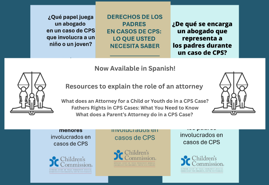
The “What Does an Attorney for a Child or Youth do in a CPS Case?” pamphlet explains the attorney’s responsibilities to a child or youth client and how to resolve any issues between the attorney and the client. The document is available for download below and may be helpful for judges to have available in the courtroom, courthouse library, or information center.
Pamphlet: The Role of an Attorney Representing Parents in a Child Welfare Case
The “What Does a Parent's Attorney do in a CPS Case?” pamphlet explains the attorney’s responsibilities to a parent client and how to resolve any issues between the attorney and the client. The document is available below and may be helpful for judges to have available in the courtroom, courthouse library, or information center.
Coloring Book: Sam and the Search for Spots - How Your Lawyer Can Help You
The Children’s Commission Legal Representation Committee created a coloring book designed to help children ages 6-12 understand the role of an attorney ad litem for a child and the attorney-client relationship in a child welfare case. The coloring book was developed by a workgroup which included law professors, board-certified child welfare law experts, and youth with lived experience in foster care and is designed to help children and caregivers discuss what makes an attorney ad litem for the child different from other people in the child’s case and how the attorney can help the child during the case through counseling and advocacy.
This publication is available in two formats at the links below: to print on a personal device, and for commercial print.
In English:
In Spanish:
For assistance or inquiries about this publication, please contact Jessica Arguijo at children@txcourts.gov.
Pamphlet: Fathers' Rights in CPS Cases: What You Need to Know
The LRC developed a resource pamphlet highlighting fathers’ rights when involved in a CPS case. Modeled after the Commission’s “What Does a Parent’s Attorney do in a CPS Case?” pamphlet, “Fathers' Rights in CPS Cases: What You Need To Know” uses accessible language to inform fathers of their basic rights in child welfare legal proceedings and explains the different legal statuses for fathers. The pamphlet is available for PDF download below.
Rights of Incarcerated Parents in CPS Cases
The Children’s Commission Legal Representation Committee developed a poster as a resource highlighting the rights of incarcerated parents in a CPS case. This resource identifies basic rights in child welfare legal proceedings and explains how parents can participate in the case and in their child’s life, subject to the rules of the institution where they are incarcerated. The poster is available for PDF download below: